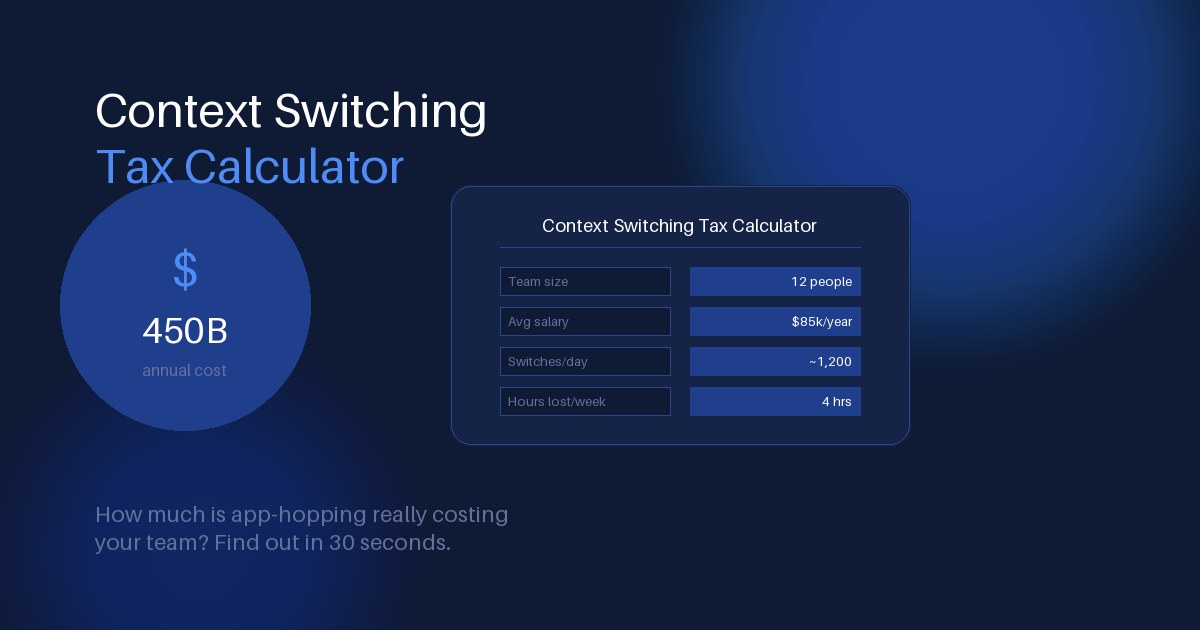
Every Slack ping, every email that needs "just a quick reply," every Asana update that pulls you out of a document -- these feel small individually. But research shows knowledge workers toggle between apps nearly 1,200 times per day. The context switching tax is real, it is measurable, and for most teams it is shockingly large. This calculator uses peer-reviewed research to show you exactly what you are paying.
The context switching tax calculator
Fill in your team details below. The figures update instantly and are based on published academic and industry research.
Notico cuts context switching by bringing all your notifications into one unified inbox.
Cut your team's tax - join waitlistWhat the research actually says
The numbers in this calculator are not guesses or industry estimates. They are derived from three independent research bodies that studied knowledge worker behaviour in real workplaces, not laboratory conditions.
A 2022 Harvard Business Review study tracked how knowledge workers actually spend their time across apps. The finding: the average worker loses nearly 4 hours every week -- not to meetings, not to email -- but purely to the act of reorienting themselves after switching applications. Compounded across a year, that is five full working weeks per person, gone.Source: Harvard Business Review, 2022
Most people underestimate this cost because each individual switch feels fast. You close Slack, open Gmail, scan the inbox, close Gmail, return to Slack. That took maybe 45 seconds. But that is not where the time goes. The real cost is what happens in your brain after the switch.
Gloria Mark at the University of California, Irvine spent years measuring focus recovery in real office environments. Her conclusion, now replicated across multiple independent studies: after a single interruption, the average person takes 23 minutes and 15 seconds to return to the same depth of concentration they had before the disruption. Not 23 minutes to finish what they were interrupted from. 23 minutes to get their head back in the same place it was.
Average cognitive recovery time after a single interruption. This is not the time to complete the interrupting task -- it is the time for your brain to re-establish the same level of focus it had before the interruption occurred.Source: Gloria Mark, University of California Irvine -- replicated in multiple field studies
Now apply that number to your day. HBR found knowledge workers toggle between apps roughly 1,200 times per day. Even if only a fraction of those switches break genuine focus, the cognitive overhead accumulates fast. The American Psychological Association studied the cumulative effect of this pattern and found that chronic context switching and multitasking consume up to 40% of a person's productive time. Not 5%. Not 10%. Forty percent. For an 8-hour workday, that means roughly 3.2 hours of output is lost not to bad meetings or poor processes, but to the mental overhead of constantly reloading context that was dropped when the last notification pulled someone away.
Why this problem is getting worse, not better
In 2019, the average knowledge worker used around 8 SaaS applications per day. By 2022, that number had risen to 10 according to Asana's Anatomy of Work Index. Today the figure sits higher still, driven by the proliferation of project management tools, communication platforms, and AI-powered assistants that each demand their own form of attention.
Microsoft's own workplace research found employees are interrupted every 2 minutes during core working hours. That is not just from colleagues -- it includes the passive interruptions of notification badges, preview banners, and the ambient awareness of unread counts sitting in browser tabs. Each of these creates what cognitive scientists call an open loop: an unresolved item that occupies a small but persistent share of working memory even when you are not actively looking at it.
The deeper mechanism is what Sophie Leroy at the University of Washington identified as attention residue. When you leave one task to start another, part of your cognitive attention remains attached to the first task. The more fragmented the switch -- a notification that appeared mid-sentence, a Slack message that came in while you were reading a report -- the stronger the residue and the longer it takes to clear. This is why people describe feeling busy all day while producing surprisingly little. They were busy. Their attention was just never fully in one place.
The important insight here is that this is not a personal failure. It is a systems problem. The tools that connect modern teams -- Slack, Gmail, Asana, Outlook -- were each built to surface their own updates as quickly as possible. None of them were designed to understand your broader workload or decide whether right now is actually a good time to interrupt you. That gap is where the productivity loss lives.
How to actually reduce the context switching tax
The strategies that work all share the same underlying logic: reduce the number of places you need to check, and reduce how often urgent-feeling notifications can interrupt focused work. Asking people to "be more disciplined" without changing the system does not work -- the research is consistent on this point. What works is structural change to how notifications reach you.
Consolidate your inboxes into one place. The single biggest driver of unnecessary context switching is having four or five separate places where work updates can arrive. Every app you need to check is a potential context switch. A unified notification inbox that pulls Slack, Gmail, Asana, and Outlook into one feed means one triage session covers everything, rather than four separate ones scattered across your day. The real cost of context switching drops significantly when you eliminate redundant checking.
Prioritise before you open. The worst form of context switching is reactive -- you check a notification without knowing whether it is urgent, and it pulls you into a thread that did not need your attention right now. AI prioritisation that reads across your notifications and surfaces what genuinely needs action first means you start each triage session already knowing where to focus, rather than discovering it by opening everything.
Batch your notification processing. Most research on focus recovery suggests two or three dedicated notification windows per day outperforms constant monitoring. The key is that these windows are intentional -- you check because you chose to, not because a badge caught your eye. Everything outside those windows stays in the inbox, processed in order, not in the order notifications happened to arrive.
Replace scanning with summaries. The most time-consuming part of notification management is not reading messages -- it is scanning to find which messages matter. An AI briefing that has already done that scanning and surfaces only the items that need a decision or a reply converts what would be 20 minutes of inbox triage into 90 seconds of reviewing a prioritised list. This is how Notico's Coffee Briefing works -- the AI reads across every connected app overnight and tells you in the morning exactly what needs your attention and what does not.
One inbox. All your notifications. Zero app-hopping.
Notico brings Slack, Gmail, Outlook and Asana into a single unified notification inbox, with AI prioritisation that tells you what is urgent, what can wait, and what needs a reply -- before you open a single app.
Join the waitlist -- it is freeCommon questions about context switching and productivity loss
How much time does context switching actually cost per day?
The most reliable figure comes from a 2022 Harvard Business Review study that tracked real knowledge workers across their apps. The average worker loses nearly 4 hours per week -- roughly 48 minutes per working day -- purely to the act of reorienting after switching applications. This does not include time spent on the tasks themselves, only the cognitive overhead of moving between them. UC Irvine research by Gloria Mark found that each individual interruption takes an average of 23 minutes and 15 seconds to fully recover from, meaning a single unexpected notification mid-task can cost nearly half an hour of focus depth even if the notification itself took seconds to read.
What percentage of productive time is lost to context switching?
The American Psychological Association research on multitasking and task-switching found that the cumulative effect of frequent context switching can consume up to 40% of a person's productive time. Applied to an 8-hour workday, that represents approximately 3.2 hours of output lost not to visible tasks but to cognitive switching overhead -- the mental cost of constantly dropping one context and loading another. The figure varies by role and tool usage intensity. Workers using more than 10 applications per day consistently show higher losses than those working across 5 or fewer.
How many times do workers switch apps per day?
A 2022 Harvard Business Review study found the average knowledge worker toggles between applications and websites nearly 1,200 times per day. Asana's Anatomy of Work Index from the same year found employees use approximately 10 different applications daily. Microsoft workplace research reported interruptions occurring roughly every 2 minutes during core hours, with over 275 interruptions per day when activity outside standard working hours is included. These numbers have increased year over year as SaaS adoption has grown and teams have added more tools without removing old ones.
Is context switching the same as multitasking?
They are related but distinct. Multitasking refers to attempting two cognitive tasks simultaneously, which neuroscience research shows humans cannot effectively do for complex mental work -- the brain is serialising the tasks even when it appears to be running them in parallel. Context switching is sequential: you stop one task and start another. The unique cost of context switching compared to simply doing two tasks in sequence is the attention residue effect -- the mental overhead of the transition itself, and the time it takes for your working memory to fully clear the previous context and reload the new one. That transition cost is where the 23-minute recovery figure comes from.
Does a unified notification inbox actually reduce context switching?
Yes, for a specific and measurable reason. A significant portion of daily app switches are not driven by work requirements -- they are driven by checking. You open Slack to see if there is anything urgent. There is not, so you close it and go back to what you were doing. Then you open Gmail for the same reason. Each of these checking switches carries the same cognitive overhead as a task-driven switch. A unified inbox eliminates the checking motive: when one feed shows you everything from every connected app, there is no reason to open each tool individually. Early data from Notico users shows a reduction of 60 to 70% in the number of individual app opens per day, which maps directly to fewer cognitive switches and more sustained focus time.
Sources: Harvard Business Review (2022) -- "How Much Time and Energy Do We Waste Toggling Between Applications"; Gloria Mark, University of California Irvine -- interruption and focus recovery research; American Psychological Association -- multitasking and productive time loss; Asana Anatomy of Work Index (2022); Sophie Leroy, University of Washington -- attention residue research; Microsoft WorkLab workplace productivity data.