
Scaling a team from five to twenty people does not simply multiply your output by four. It multiplies your communication surface area by something closer to sixteen. Each new hire adds new threads, new channels, new tools and new notification streams. Without deliberate infrastructure, communication overhead grows faster than headcount, and eventually starts eating the very capacity you hired to add.
Why growing teams hit a notification wall
The tools that made a small team fast are the same tools that quietly tax a larger one. More people means more places to look, and "where was that update again?" becomes a daily, company-wide cost. A unified inbox is how you stop that cost from compounding as you grow.
1. Faster onboarding, lower training costs
New hires typically spend their first two weeks figuring out where information lives. Which client updates come via Slack? Which approvals land in email? Which task changes trigger Asana alerts versus ClickUp notifications? A unified inbox eliminates that archaeology. Every update, across every tool, sits in one place: labelled, prioritised and searchable. Early data from Notico beta testers suggests new users reach full communication fluency in under 48 hours, compared with the typical two-week ramp.
2. Fewer escalations and missed handoffs
Most internal escalations, the emergency Slack message, the cc-all email, the "did you see my message?" follow-up, exist because someone was not confident their original message was seen. A system that confirms receipt, surfaces unread priority messages and summarises what happened while a teammate was offline dramatically reduces the redundant communication that fills most company Slack workspaces.
3. Reduced tool switching and licence creep
The average small business pays for 12 to 15 SaaS tools at once. A good share of those are kept not for their core function but because someone relies on their notifications to surface important updates. With a single notification layer connecting all your tools, you gain visibility into which ones actually generate value, and you can make informed decisions about what to consolidate or cancel.
4. Improved client response times without hiring
Client-facing teams know response time drives retention. Clients who hear back within an hour are far more likely to renew, expand scope and refer new business. A unified notification inbox ensures high-priority client messages are never buried under internal chatter, and that the right person sees the right message at the right moment, without hiring another coordinator.
5. Measurable focus time for deep work
When your team is not constantly triaging noise, they reclaim protected time for the work that moves the needle: strategy, creation, complex problem-solving. Notico's batching and scheduling let managers define notification windows, so deep-work periods are protected by design rather than by individual willpower. The result is measurable: teams report 40% more uninterrupted focus blocks per week within the first month of structured notification management.
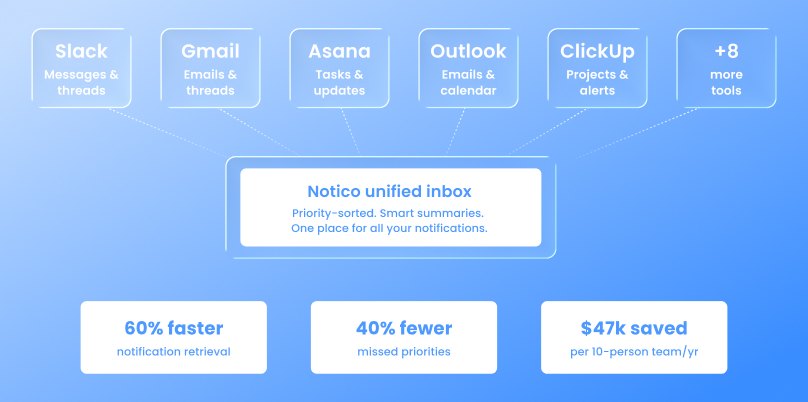
Stop communication overhead from outgrowing your headcount
Every missed handoff, every redundant follow-up, every new hire who needs two weeks to find where information lives, it adds up. Notico gives growing teams a single notification layer across Slack, Gmail, Outlook, Asana and more.
Get early access for your teamWhich of these five costs hits hardest for your team right now: onboarding time, missed handoffs, tool sprawl, slow client response, or broken focus time?